ASTM tensile testing | SLA printing | Material property analysis
Overview
In partnership with Rutgers School of Engineering via the New Jersey Governor's School, I and my team conducted experimental research investigating how layer thickness and print orientation affect the mechanical properties of SLA 3D printed parts. Using controlled tensile testing, this work explored how printing parameters influence stiffness, strength, and failure behavior, contributing to a deeper understanding of additive manufacturing performance.
The Problem
While 3D printing enables rapid prototyping and complex geometries, it often sacrifices mechanical strength compared to traditional manufacturing. Understanding how controllable parameters—such as layer thickness and print orientation—affect material performance is critical for expanding real-world engineering applications of additive manufacturing.
Approach
I designed and executed a structured experiment using SLA printing to isolate the effects of two variables: layer thickness and print orientation.
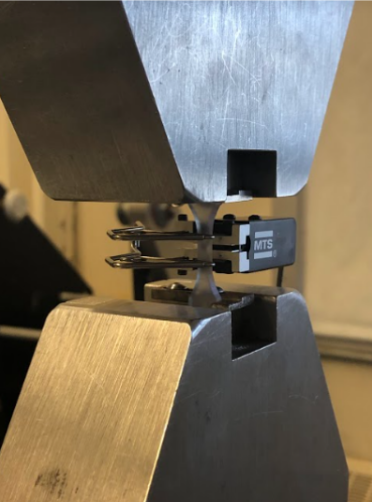
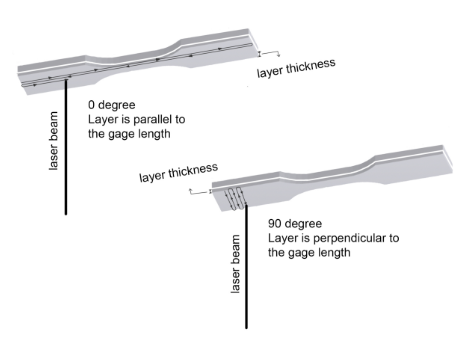
Tensile specimens were printed using three layer thicknesses (25 µm, 50 µm, and 100 µm) and three orientations (0°, 45°, and 90°), resulting in nine distinct sample conditions. All specimens were tested under standardized ASTM D638 tensile testing procedures using an MTS universal testing machine to measure stress-strain behavior, Young’s modulus, and failure characteristics.
Tools & Methods
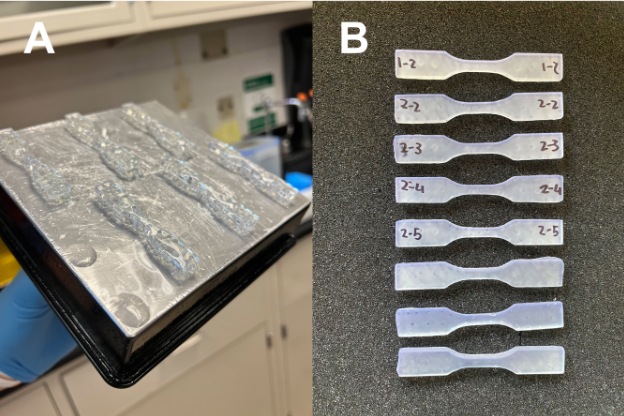
This project combined CAD, manufacturing, and experimental testing. SolidWorks was used to design standardized tensile specimens, SLA printing (Formlabs Form 2) for fabrication, and mechanical testing equipment to generate stress-strain data. Post-processing included cleaning, curing, and preparing samples for consistent testing conditions.
Key Results
Layer Thickness Tradeoffs:
Thinner layers (25 µm) produced the stiffest and strongest parts but were more brittle, failing at lower strain. Thicker layers (50 µm) produced tougher parts that could deform more before breaking.
Thinner layers (25 µm) produced the stiffest and strongest parts but were more brittle, failing at lower strain. Thicker layers (50 µm) produced tougher parts that could deform more before breaking.
Orientation-Dependent Behavior:
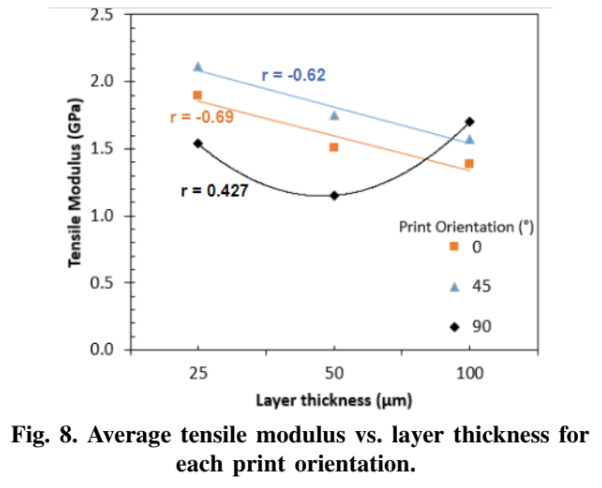
Print orientation significantly affected mechanical performance. For thicker prints (100 µm), stiffness increased with orientation angle, with 90° prints showing the highest modulus. However, this trend was not consistent across thinner layers, indicating complex interactions between variables.
Print orientation significantly affected mechanical performance. For thicker prints (100 µm), stiffness increased with orientation angle, with 90° prints showing the highest modulus. However, this trend was not consistent across thinner layers, indicating complex interactions between variables.
Strength vs. Ductility Tradeoff:
A clear inverse relationship emerged between stress and strain at failure: stiffer samples resisted deformation but fractured earlier, while more ductile samples absorbed more strain before breaking.
A clear inverse relationship emerged between stress and strain at failure: stiffer samples resisted deformation but fractured earlier, while more ductile samples absorbed more strain before breaking.
Challenges
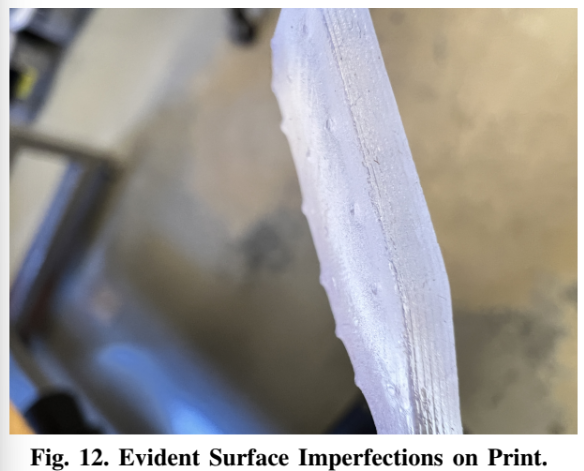
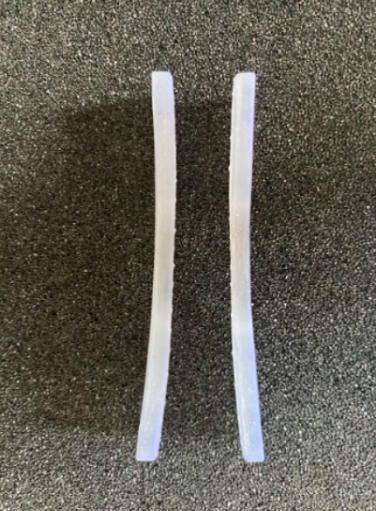
Experimental variability introduced challenges in data consistency. Surface imperfections from support structures created stress concentrations that influenced failure points. Variations in post-curing time and slight geometric inconsistencies also introduced noise into the results.
Additionally, small sample sizes made the data sensitive to outliers, requiring careful interpretation and selection of representative results.
Outcome
The study identified clear tradeoffs between stiffness, strength, and toughness in SLA printed parts, demonstrating that print parameters can be tuned to optimize for specific performance requirements.
For example, parts requiring high stiffness benefit from low layer thickness and aligned print orientation, while parts requiring toughness benefit from alternative configurations.
Reflection
This project strengthened my ability to design controlled experiments, analyze material behavior, and interpret noisy real-world data. It also reinforced how manufacturing decisions directly impact mechanical performance, particularly in emerging technologies like additive manufacturing.