Engineering Design · Finite Element Analysis · Structural Optimization
Overview
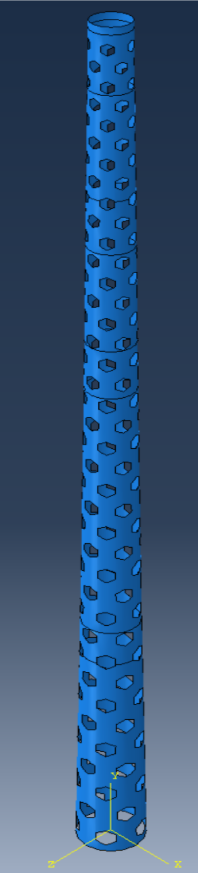
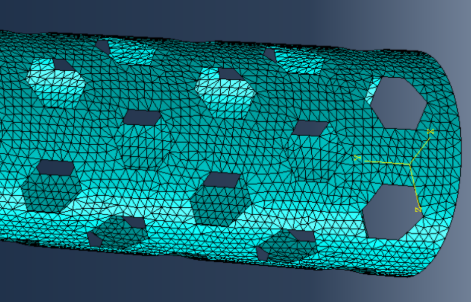
Designed and evaluated a novel wind turbine tower geometry using honeycomb cutouts to reduce material usage while maintaining structural integrity. Conducted a large-scale parametric study using finite element analysis (FEA) to explore how geometric variations impact strength, buckling behavior, and mass.
The Problem
Modern wind turbines are rapidly increasing in size, leading to towers that require tens of thousands of pounds of steel and composite materials. Reducing material usage without compromising structural performance is critical for improving sustainability and cost efficiency.
Approach
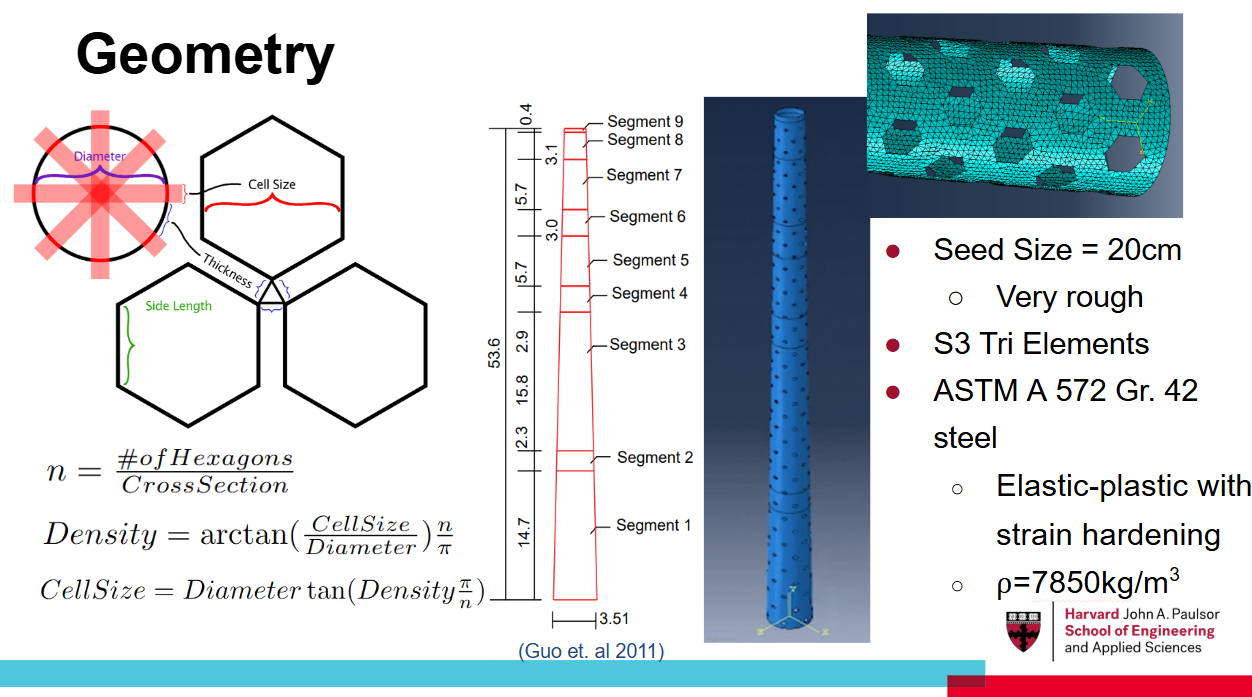
I developed a computational workflow to generate and analyze wind turbine towers with hexagonal cutouts. The base geometry was a validated 53.6-meter tower model, allowing direct comparison to real-world designs.
Each tower was parameterized using two variables: the number of hexagons per row (N) and the density of material removed. By sweeping these parameters, I generated and tested 110 unique tower designs.
Finite element models were built in ABAQUS using shell elements, and each design was evaluated through three analyses: buckling behavior, lateral pushover response, and representative turbine loading conditions.
Tools & Skills
This project combined simulation, programming, and mechanical design. I used ABAQUS for finite element modeling, Python to automate geometry generation and data processing, and CAD techniques to construct and manipulate complex geometries. The work also involved structural mechanics, buckling analysis, and data visualization.
Key Results
Mass Reduction:
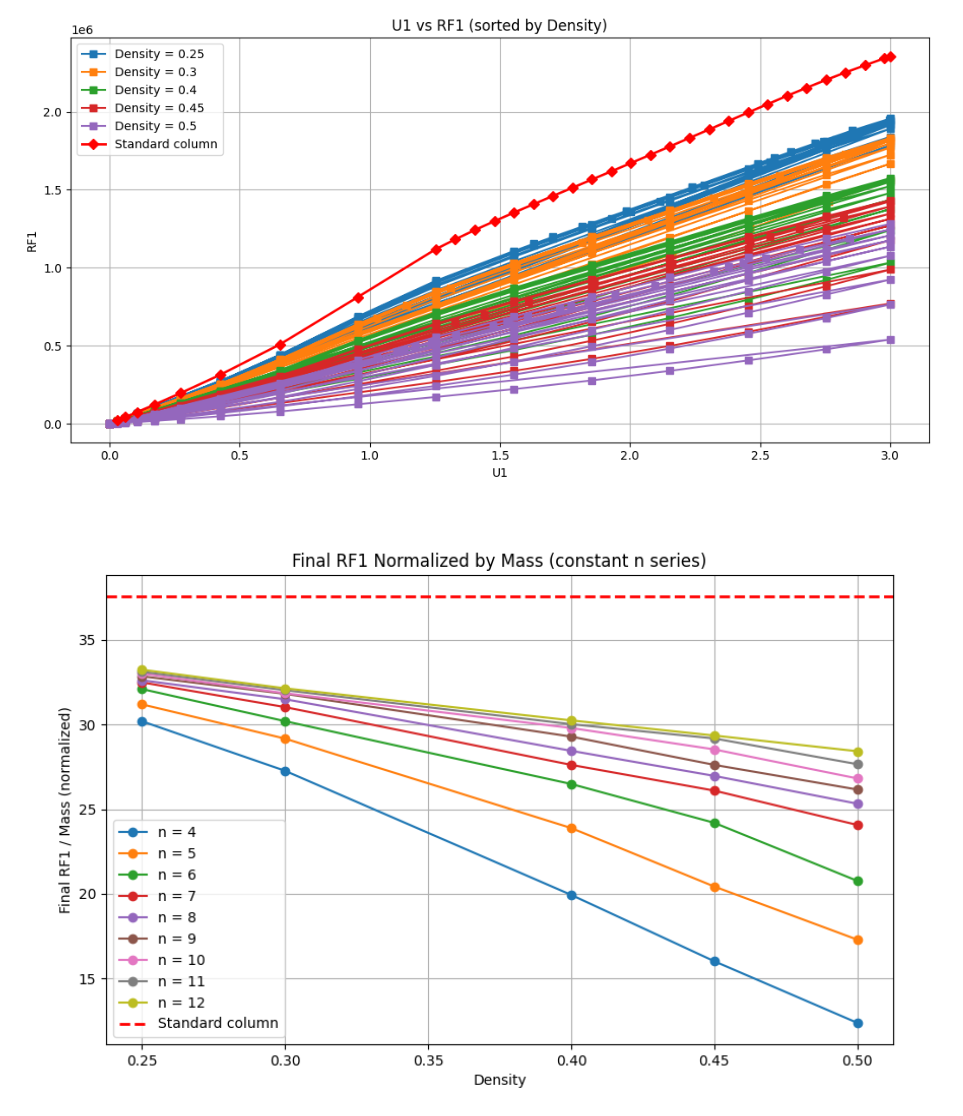
Increasing the density of honeycomb cutouts consistently reduced the overall mass of the tower. However, this introduced tradeoffs with structural performance.
Increasing the density of honeycomb cutouts consistently reduced the overall mass of the tower. However, this introduced tradeoffs with structural performance.
Buckling Behavior:
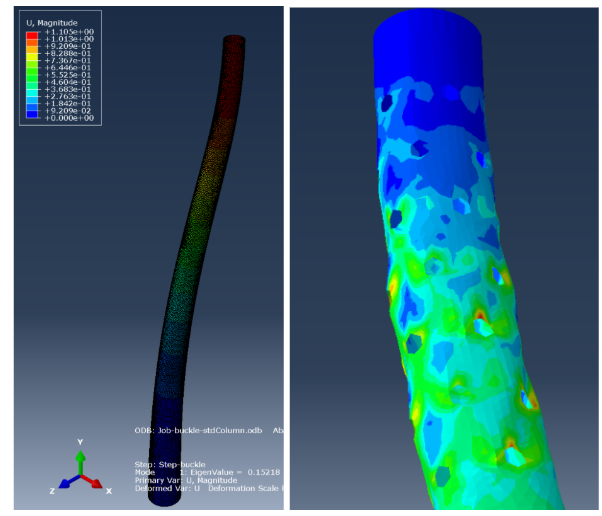
Towers with lower density and higher numbers of smaller hexagons most closely matched the buckling behavior of a standard tower. Certain parameter combinations produced unrealistic deformation modes, revealing geometric and modeling limitations.
Towers with lower density and higher numbers of smaller hexagons most closely matched the buckling behavior of a standard tower. Certain parameter combinations produced unrealistic deformation modes, revealing geometric and modeling limitations.
Structural Strength:
The standard solid tower remained the strongest configuration overall. The best-performing optimized design (N = 12, density = 0.25) achieved meaningful mass reduction while approaching the strength of the baseline design.
The standard solid tower remained the strongest configuration overall. The best-performing optimized design (N = 12, density = 0.25) achieved meaningful mass reduction while approaching the strength of the baseline design.
Stress Distribution:
Stress concentrations formed around the honeycomb cutouts and in thinner tower segments, highlighting a key limitation of material removal strategies.
Stress concentrations formed around the honeycomb cutouts and in thinner tower segments, highlighting a key limitation of material removal strategies.
Challenges
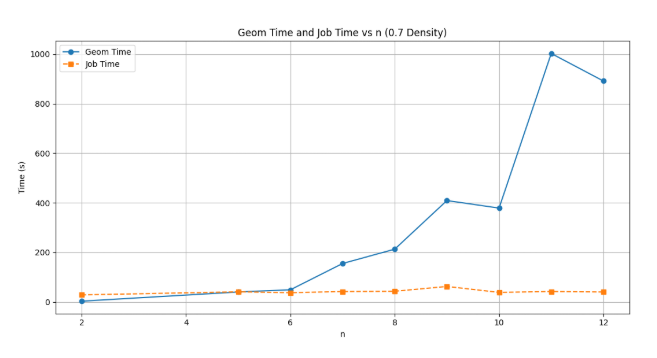
Applying a repeating honeycomb pattern to a tapered cylindrical surface introduced geometric complexity. Larger or denser patterns caused distortion, self-intersections, and inconsistent rib thickness. Mesh resolution also limited accuracy, and simulation time became a bottleneck when scaling to over 100 design variations.
What I Learned
This project showed that structural optimization is highly sensitive to geometry and mass distribution. Removing material does not guarantee improved efficiency; strength-to-weight tradeoffs must be carefully balanced. It also reinforced the importance of automation when running large parametric studies, and the need to critically evaluate simulation results for physical realism.